
Time to Read 10 min
Modified
The EU’s Ecodesign for Sustainable Products Regulation (ESPR) has been in effect since July 2024. It expands the scope of the former Ecodesign Directive to cover nearly all physical products. Here’s what applies to your electronics:
How much pressure is there regarding this issue? For industrial electronics, the answer is: You have time, but stay vigilant. We’ve compiled here what applies today and how you can tell when that time runs out.
Both terms mean the same thing. ESPR stands for the English title “Ecodesign for Sustainable Products Regulation.” In German, it is usually referred to as the Ecodesign Regulation. This occasionally leads to confusion with the superseded Ecodesign Directive 2009/125/EC.
The full title is “Regulation (EU) 2024/1781 of the European Parliament and of the Council of June 13, 2024, establishing a framework for setting ecodesign requirements for sustainable products, amending Directive (EU) 2020/1828 and Regulation (EU) 2023/ 1542, and repealing Directive 2009/125/EC.”
It is available on EUR-Lex: ESPR
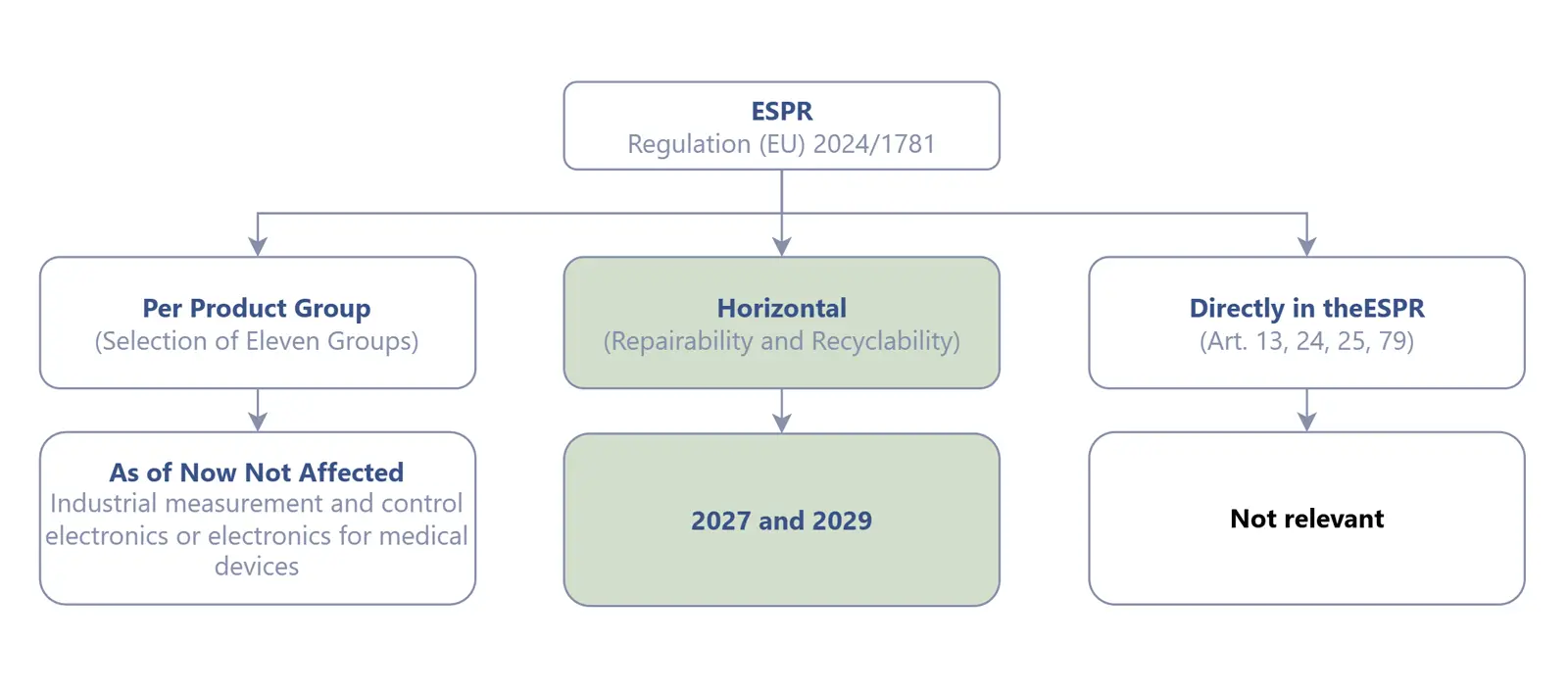
The ESPR primarily sets out the framework for future product-specific requirements. It establishes how these requirements are developed. What this means specifically for your product is outlined in the delegated act for your product group.
However, some provisions are already directly applicable. These include
None of these provisions currently apply to your industrial electronics or medical devices. However, the Ecodesign Regulations that remain in effect under Article 79 may apply to you through purchased components; see „Our device is not regulated. Does this still affect us?”
The regulation aims to improve the circularity and environmental sustainability of products in the EU internal market. It identifies a number of product aspects relevant to this goal. These include durability, reliability, repairability, upgradability, recyclability, the proportion of recycled content, substances of concern, and the carbon footprint.
The delegated act specifies which of these aspects apply to your product.
For a delegated act concerning a single product group, experience shows that it takes three to five years from the preparatory study to its entry into force. This is followed by an 18-month period until the act takes effect.
Iron and steel is the group that is furthest along in the process. The public consultation ran from May 20 to August 12, 2026. Adoption is expected in the fourth quarter of 2026. Between adoption and entry into force, there is still the objection period for the Parliament and the Council, as well as publication. The act will therefore become applicable no earlier than the end of 2028.
For the horizontal measures, the initial phase of this timeline does not apply. The clock is already ticking there. The preparatory study on reparability has been underway since April 2025, and adoption is tentatively scheduled for 2027. Depending on when in 2027 adoption takes place, the effective date will thus fall in the second half of 2028 or in 2029.
Whether this date applies to you at all is determined not by the timeline, but by the scope of application. This scope is currently being developed. The next version of the JRC study in the fourth quarter of 2026 is when you’ll see this for the first time. As long as capital goods are not included there, this is a strong indication that this deadline does not apply to you for the time being.
In the case of a legal act specific to your own product group, however, you would have several years from the start of the preparatory study, and you could participate in the consultation process.
In addition to the product groups covered, it includes two horizontal measures. These are intended to apply across all product groups.
In addition, work will continue on approximately 16 energy-related product groups from previous work plans. A mid-term review is scheduled for 2028.
The Commission’s Joint Research Center (JRC) has been conducting the preparatory study since April 2025. A first draft report was published in October 2025. The first stakeholder meeting took place on November 18, 2025. The next version is scheduled for the fourth quarter of 2026. The delegated act is tentatively scheduled for adoption in 2027.
The work plan identifies consumer electronics and small household appliances as a possible scope of application. The product lists discussed so far fall within this category. They range from audio devices and electric scooters to small kitchen appliances and personal care devices. Industrial measurement and control technology has not been included thus far.
If you develop consumer electronics, your situation is therefore quite different. In that case, it’s worth taking a look at the ongoing study and the consultation.
Directive (EU) 2024/1799 is a separate legal act. It has been applicable in the Member States since July 31, 2026.
The repair obligation applies to the product groups exhaustively listed in Annex II, including smartphones and tablets, washing machines, dishwashers, refrigerators, displays, vacuum cleaners, welding equipment, as well as servers and data storage products. However, it applies only to consumers. A welding machine or server that you sell to a business is therefore not covered. Medical devices are not included.
The complete and binding list can be found in Annex II of the Directive (EU) 2024/1799.
Annex II does not list the products directly but refers to the respective ecodesign legislative acts. As the range of products regulated by ecodesign legislation expands, the scope of repair obligations indirectly expands as well. However, this is only relevant to you to the extent that you sell to consumers.
As a directive, it is transposed into 27 national laws. The penalties vary accordingly.
You are subject to a repair obligation regardless of this directive. See the next question regarding batteries for more information.
Yes, as of February 18, 2027. Article 11 of the Battery Regulation (EU) 2023/1542 requires that device batteries be removable and replaceable by the end user.
Three points are easily overlooked here. The obligation applies not to the battery manufacturer, but to the party that places the device with the built-in battery on the market. The regulation refers to the end user, not the consumer. A facility operator is an end user.
„Easily removable” means that standard tools are sufficient. No special tools, no heat application and no solvents. This refers to the battery as a whole, not to individual cells. Exceptions exist, such as when a permanent connection is necessary for safety or data integrity reasons; these exceptions are narrowly defined. The Commission has published guidelines on this (Official Journal C, 2025/214). While they are not legally binding, market surveillance authorities generally follow them in practice.
One question is therefore worth asking today: Where is the battery located in your device, and how can the operator access it?
The ESPR prohibits the destruction of unsold consumer products in certain categories. It also requires transparency regarding destruction.
As of July 19, 2026, the ban applies to unsold clothing, clothing accessories, and shoes from large companies. Medium-sized companies will follow in 2030.
It does not currently apply to electronics. The Commission may expand the scope via a delegated act.
Unlike the CRA, the ESPR does not specify EU-wide maximum amounts. Article 74 requires Member States to establish effective, proportionate, and dissuasive sanctions. These include fines and temporary exclusion from public procurement procedures. The specific amounts are determined by the laws of your target markets. Germany, for example, has passed an Ecodesign Modernization Act, which will take effect on November 1, 2026.
For manufacturers, however, something else poses a major risk. Under Regulation (EU) 2019/1020, market surveillance authorities may prohibit the placing of products on the market, order a recall, or halt a shipment at the external border. A halted production run hits harder than a fine. Who the authority targets depends on the roles involved. This brings us to the next question.
A violation of ecodesign requirements presupposes that a delegated act applies to your product, including the horizontal ones. Regardless of this, Articles 24 and 25 apply directly. They are not currently relevant to your products.
Within the scope of this page, your risk of sanctions therefore currently lies with RoHS, REACH, POPs, and WEEE. These have their own national fine regimes.
The Commission has announced a proposal for the second half of 2026.
The Act aims to create a single market for secondary raw materials, reduce the fragmentation of extended producer responsibility (EPR), and lower dependence on imported critical raw materials. The revision of the WEEE legislation is to take place in conjunction with the planned circular economy measures.
For electronics manufacturers, this may become more relevant than the ESPR itself. A WEEE revision and harmonized EPR rules will build upon obligations that you are already required to fulfill today.
To put this ambition in context: The EU estimates its circular materials rate at around 12 percent and aims to double it by 2030.
The ESPR itself does not currently impose any obligations on industrial measurement and control electronics. Your actual effort in complying with European regulations lies with RoHS, REACH, POPs, and WEEE; your specific risks stem from purchased components and from what your customers will require of you.
Things will only get serious once the horizontal requirements begin to apply to capital goods for the first time.
Do you need support with projects and certification? Solcept develops products, electronics and software, and we conduct certifications.
Marcel Wattinger
Do you have additional questions? Do you have a different opinion? If so, email me or comment your thoughts below!

is a dipl. Elektroingenieur FH and Wirtschaftsingenieur with a focus on project management. He has more than two decades of practical experience in the field of electronics and leads interdisciplinary teams in transforming innovative ideas into reliable products that create added value. He combines analytical strength with a coaching mentality and turns challenges into shared learning experiences. Marcel enjoys being mindful in nature. Step by step, he is making his way toward Rumi's field: “Out beyond ideas of right and wrong there is a field. I'll meet you there!”
Projects? Ideas? Questions? Let's do a free initial workshop!
No Comments